


When we hear the word technology, we usually think of a cell phone or computer, state-of-the-art sensors, facial detectors or Artificial Intelligence. But in reality what defines what is technology and what is not, is its purpose and usefulness in a given context. Technology encompasses all the knowledge, techniques and tools that people create to solve problems, satisfy needs and transform our environment. In other words, the invention of the wheel, the knife or the control of fire were also technological creations.
At its core, technology is the practical application of science. While science seeks to understand the universe and generate knowledge, technology takes that knowledge to create tangible solutions that improve the quality of life. To understand its evolution and current scope, the UNESCO highlights how today's technological development demands a global framework that prioritizes human rights and sustainable development.
Why is technology important?
Technology is the main driver of human development, productivity and globalization. And therein lies its importance. Today, it is the backbone of critical sectors such as medicine, education, finance and communication.
Among its main virtues, the following stand out:
- Optimization and automation: It enables complex tasks to be performed in a fraction of the time, reducing operating costs and increasing business efficiency.
- Access to information: It democratizes knowledge, allowing millions of people to access education and data in real time from anywhere in the world.
- Medical advances: The development of health technology has made it possible to increase global life expectancy.
- Economic impact: According to the global report on digital development of the World Bank, The digital economy and mobile connectivity infrastructure are the largest source of youth employment.
But its importance is not neutral. Technology can expand rights or violate them, democratize access or deepen inequalities, depending on who designs it, with what criteria and for what purpose. That is why responsible technological development requires a diversity of views, ethical frameworks and the active participation of society as a whole.
What to study if I like technology?
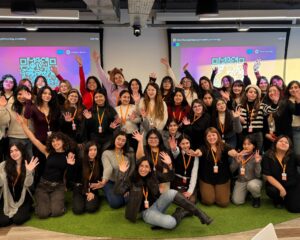
The technology ecosystem offers one of the highest employability rates and the most competitive salaries in the current labor market. For this reason, at Chicas en Tecnología we seek to expand the participation of women in the sector, as at present only 3 out of 10 people studying these careers in Latin America are small.
When technology is created by people with similar profiles, it ends up responding to the needs and biases of that group. Facial recognition systems that fail with women and racialized people, algorithms that replicate historical discriminations or devices designed for male bodies are concrete examples of what happens when diversity is absent. More representation is not just a matter of fairness: it is a condition for technology to work better for all people.
If you are passionate about this world, the most demanded careers and disciplines are divided into different approaches:
- Software Development and Programming: Careers such as Computer Engineering, Computer Science or web and mobile development. They allow you to create the applications, platforms and tools that the world uses every day.
- Data Science and Artificial Intelligence: Disciplines focused on the analysis of large data volumes (Big Data), machine learning (Machine Learning) and language models.
- Cybersecurity: One of the areas with the greatest global talent shortage, responsible for protecting organizations' digital infrastructure and data from cyber threats.
Why learn science and technology?
Learning science and technology, especially from childhood and adolescence, transforms the way we interact with the world. It allows us to:
- Develop critical thinking: science and technology teaches how to formulate questions, test hypotheses, analyze data and solve problems in a logical and structured manner.
- Bridging the digital divide: Understanding how digital tools work prevents social and economic exclusion.
- Encourage innovation and entrepreneurship: It provides the conceptual foundations needed to create proprietary solutions, launch technology-based projects (startups) and automate everyday tasks (e.g., using Python scripts to optimize workflows).
- Exercising digital citizenship: Understanding how technology works allows us to decide with autonomy how we use it, what data we share, what systems we question and how we demand that it respects our rights.
Why is technology advancing so fast?
Every technological improvement today powers the one that will come out tomorrow, which is why it advances so fast. For example, today's supercomputers and AI models are used to accelerate scientific research, discover new materials and program software more efficiently.
In addition, high commercial competition pushes companies to innovate and invest large sums of money to maintain their relevance in the global market. At the same time, the Internet allows scientists and developers from different continents to collaborate in real time, share open-source code and accelerate discoveries.
Do you want to be part of the change? At Chicas en Tecnología we accompany Latin American women between the ages of 13 and 23 to take their first steps in the industry.