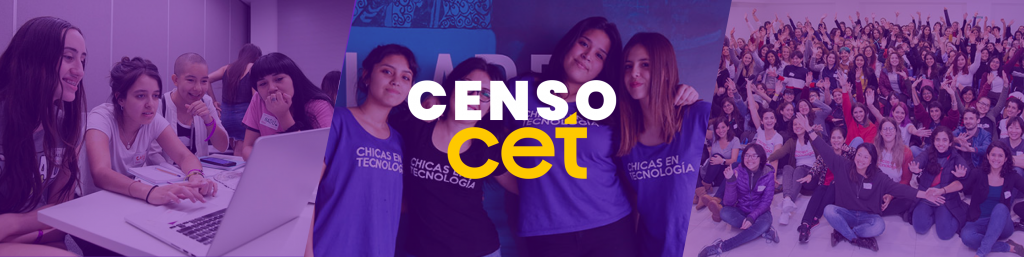


What happens when a group of young women who have just completed their data science training decide it's time to inspire others? That's exactly what the Data Club, a volunteer program of the CET Community where graduates of the Intensive Data Analytics Course went from being students to taking the lead: over the course of 10 weeks, between April and June, they designed, planned, and implemented their own workshops for other young women.
There were two teams, two formats, and one common goal: to demonstrate that data expertise, when shared, multiplies its impact.
Data Lab: Building a More Just Society (In-Person)
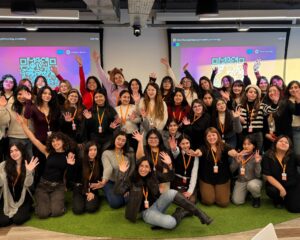
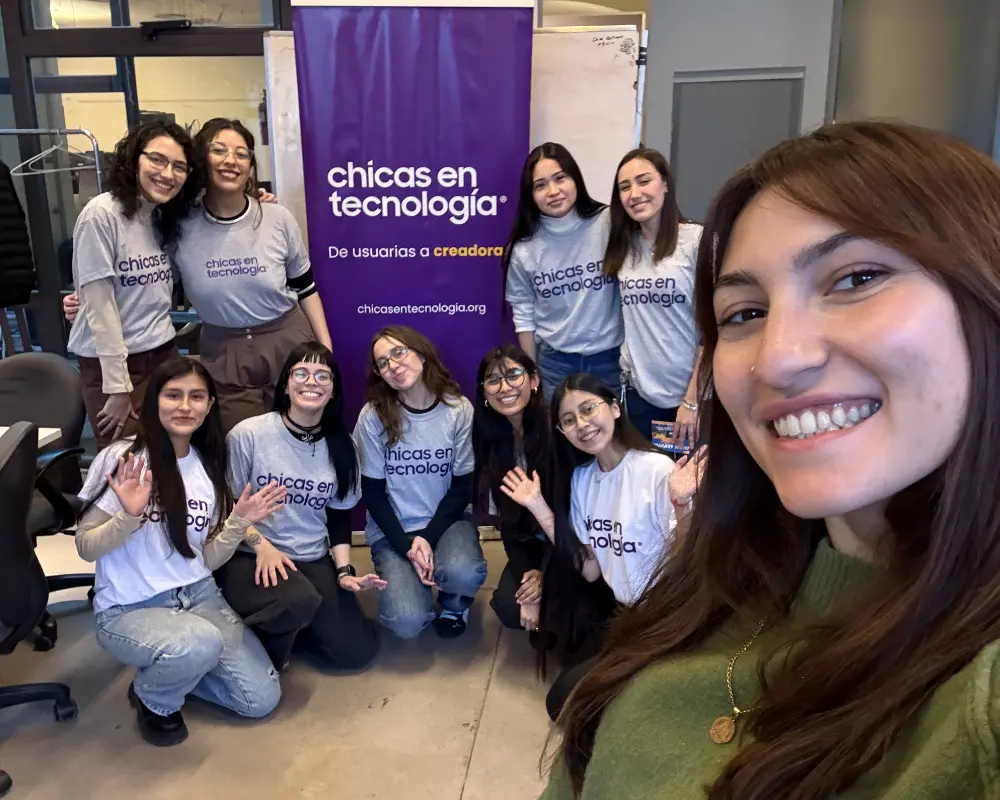
In Buenos Aires, eight volunteers and graduates of the CET Community —Dandelion Bruno Ruiz, Gabriela Galarza, Giovanna Messina, Nicoll Cruz Villegas, Sofía Bombino, Rocío Belén Ramos, Morena Rocha Alcaraz, Micaela Sol Cariaga, and Valentina Gamarra—worked collaboratively to create Data Lab: Building a More Just Reality, a free in-person workshop.
The event took place on Saturday, June 27, at Puerta 18 and was facilitated entirely by the team itself. Using a theoretical and practical approach, the participants explored data analysis and visualization, as well as the Design Thinking methodology, to develop technological solutions with social impact. Building on this, they developed proposals to identify and reduce biases in the apps and tools they use every day, strengthening both their critical thinking and their technical skills.
Creative Data: The Art of Data (virtual)
From various parts of the country, six volunteers and graduates of the CET Community—Tiara Fernández (Neuquén), Sofía Arias (Salta), Florencia Barrios (Corrientes), Magalí Martínez (Jujuy), Florencia Preaud (Misiones), and Sabrina Bidal (Entre Ríos)—came together to Creative Data: The Art of Data, a free online workshop open to young people throughout Latin America.
The meeting took place on June 17 via Zoom. The participants explored how data can become a tool for both social impact and artistic expression. Through inspiring examples—such as the use of data in creative disciplines, including music through the MiMU gloves—the young women discovered new ways to visualize the potential of data. Using Design Thinking tools and collaborative work, they designed a prototype for a technological artwork based on data from a national survey.
Leadership is also something you learn by doing
Beyond the workshops they created, the process of co-creation, organization, and implementation was in itself a learning experience for the 15 members of the Data Club. Time management, planning, collaborative work, assertive communication, task prioritization, and coordination with institutions: all key skills for leadership and employability that were put to the test—and strengthened—over the course of these 10 weeks.
Thus, the volunteers not only shared what they had learned with other young women but also solidified their own leading role within the CET Community, demonstrating that the chain of knowledge transfer in technology can (and should) be sustained among peers.