
What does it mean to be a leader? For a long time, the idea of leadership was associated with occupying visible positions, holding a position or assuming a formal leadership role. However, at Chicas en Tecnología we work from a different perspective: we understand leadership as the ability to generate impact, even in everyday life.
From this point of view, leadership does not necessarily imply being in charge, but being encouraged to speak up, propose ideas, accompany other people and transform one's immediate environment. It is a practice that can be exercised in different spaces -a school, a group of peers, a community- and that does not respond to a single model or a predefined form.
With this approach, the 2026 Leadership Lab, an intensive program designed for young people in our community who seek to develop tools to empower their voice and participation in the technological ecosystem, was carried out.
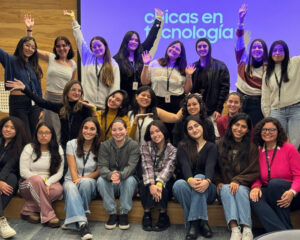
During the month of February, more than 60 young people from different Latin American countries took part in this experience. During three days of virtual work, they shared spaces for training, exchange and reflection on leadership, professional development and the role they can play as leaders in technology. Far from being an exclusively training space, the laboratory was also built as a meeting place, in which the collective dimension played a central role.
In this sense, one of the premises that runs through the work of Chicas en Tecnología is that there is no leadership without community. We propose to understand leadership as a practice that is built with other people, in dialogue, in a network and in collaboration. This implies not only developing one's own skills, but also generating conditions so that others can participate, grow and find their place.
At the same time, the lab seeks to broaden the ways in which leadership is conceived, especially in a sector such as technology, where the participation of women in decision-making roles continues to be low. According to our latest research, Parity in Code, in the largest technology companies in Argentina, women occupy only 20% of management positions. In this context, promoting diverse leadership implies recognizing that there is no single valid profile: it is possible to lead with empathy, creativity, listening or organizational skills. In all cases, it is a matter of valuing one's own voice, history and experiences as part of the exercise of leadership.
As a result of this process, the participants who completed all the laboratory stages became CET Ambassadors, assuming an active role within the community. From this place, they will be able to make their paths visible, accompany other young women and encourage more girls to approach the world of technology, contributing to reduce the gender gaps that still persist in the sector.
The Leadership Lab is not intended as a point of arrival, but as an instance that enables new paths. In a context where the need for more women in leadership roles in technology is increasingly evident, creating spaces for training, meetings and support becomes key to expand opportunities and build a more diverse and inclusive ecosystem.