
#8M | International Women's Day
In an economically challenging global context, and an Argentina with its own difficulties to ensure the social welfare of the population, there are data that point to technology as a possible way forward to reverse the situation. This industry crosses more and more productive sectors, at the same time that there are changes in the way of thinking about processes, management and, undoubtedly, an update of the professional profiles needed to integrate technological solutions to the different areas. The current scenario makes the bet on activities with an intensive use of technology -such as those activities related to the knowledge economy- a long-term development strategy. To advance along this path, a comprehensive approach is needed that takes into account essential aspects such as the integration of diverse work teams and training in the skills required by the new production paradigm. Research data “An unequal career: the gender gap in the Argentine university system.” (CET, 2022) show that this is still a challenge: every 100 female students, only 1 chooses a programming career, while women only represent 34% of people studying science, technology, engineering and mathematics careers. Chicas en Tecnología talked about this present under construction with Victoria Penacca, a professional who trained in pedagogy and developed in the technology industry driven by curiosity and the certainty that infinite possibilities for human development can be found there.
An interdisciplinary tour
Victoria Penacca is a university professor in Educational Sciences, with a diploma in Quality in Educational Systems. She specializes in project leadership and consulting in training and development processes. At work, she is Project Manager at Argencon, an association of companies in the knowledge economy. These are industries that involve the contribution of human knowledge to add value and create new products and services. The growth potential and the need for more profiles for these activities combine social, economic and community objectives, explains Victoria.
What is the role of innovation in the knowledge economy?
I cannot imagine innovation without the application of knowledge. Today, innovation in any sector of the economy is fundamentally centered on technological development. They are indispensable partners. The knowledge economy can be seen as a sector in itself, but its application is transversal. For example, banks today cannot live without people handling the whole technological aspect. From the teller to the website. There is an application that is transversal to almost all areas of the economy, which is also why there is so much demand for people trained in these subjects.
Argencon stresses the importance of creativity in the world of work, what is its importance in the knowledge economy industry?
Creativity is a human capacity and innovation is the application of that creativity. A person can be creative when he makes a recipe, when he plays with his pet, we apply creativity in everything. When we face an innovation we usually do it based on what we know and then we learn a new language and exploit its possibilities. What creativity and innovation do is to take advantage of those possibilities. In that sense, technology opens infinite doors; every person who invented a technology in history had no idea how it would end up being used. That is where creativity and innovation play an inseparable role from technology, in expanding these possibilities. For me, it is also what makes technology not a mechanization but a tool for human development.
How can human development be achieved in an area where there are gaps such as gender?
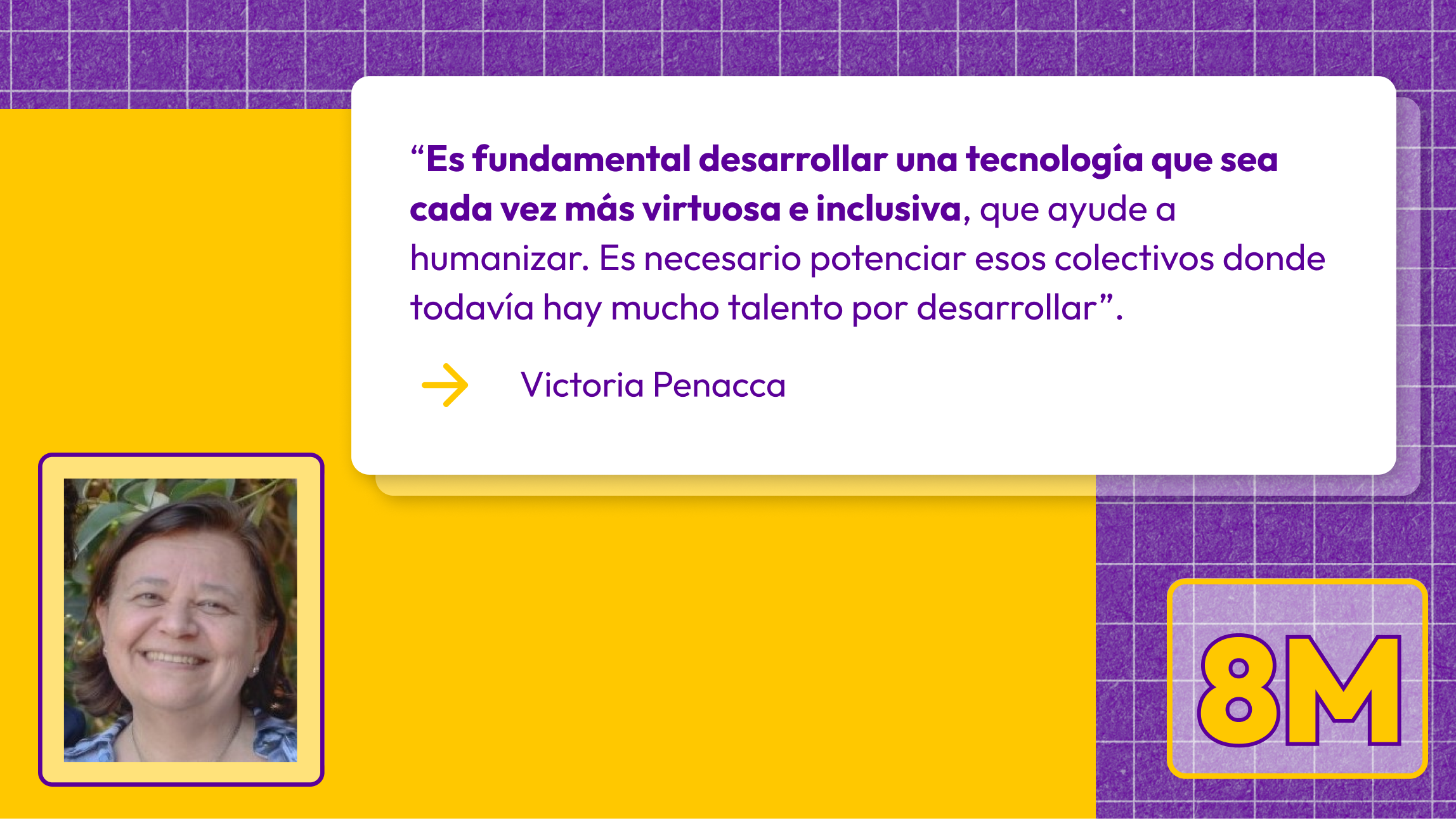
Technology today is the lever of development. And what we want to achieve is equity, an inclusion of all diversities. We want it as people, as companies, there are many studies that show that diversity is something positive because it produces better results. Society values diversity and inclusion more and more, so it would be unconscionable for companies to isolate themselves from this interest. If we do not integrate the groups that are excluded in the use of technology into technology companies, we will generate more gaps. Technology is very inclusive, for example, it allows people with disabilities to do jobs that they could not do before. So, if we do not reduce the gender gap, we are widening it because women who are not integrated into the knowledge economy will be even more marginalized. The focus of economic development will be centered on the knowledge economy, it is a sector in constant growth, and if women are not included, this will generate more exclusion. Women's perspective is fundamental. When technological development is not done with an inclusive perspective, distortions are generated. If you think technology from a biased point of view, you generate a technology that excludes. It is essential to develop technology that is increasingly virtuous and inclusive, that helps to humanize. It is necessary to empower those groups where there is still a lot of talent to be developed.
Victoria is categorical about the possibilities that young women can find in the technological field: “I would tell them to think that whatever they like or are interested in will have, in the present and in the future, a technological component. I would ask them if they want to be spectators or if they want to be protagonists. If you want to be protagonists in your lives, lose your fear of technology, get involved, and you will be empowered in a way you can't even imagine”.
The Argentine panorama
The Argentine Software Industry Chamber reported that 14,800 new jobs were created in 2021 with respect to the previous year. Since 2015, employment has grown steadily, generating almost 40 thousand new positions. Among the most sought-after profiles are roles in mobile application design, machine learning and robotization specialists, as well as those linked to data science, senior development and software architecture.
Chicas en Tecnología works so that young women in Argentina and the region who identify with the female gender consider technology as an option for their training and professional development. The participation of women in all their diversity in the areas where technological solutions are created and designed will make it possible to generate inclusive services and products and to lead scientific and technological advances from an enriched and contemplative perspective of a greater variety of social needs.
“An unequal career: the gender gap in the Argentine university system.”
+ Download images with the research data in this link.
+ Learn about the main findings of the research in this link.
+ Access the complete research in this link