
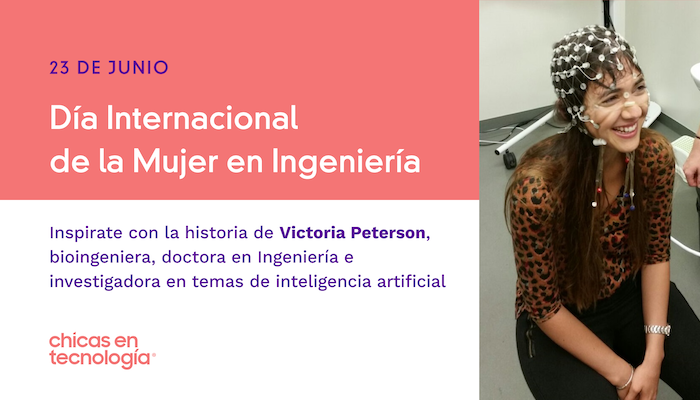
Victoria Peterson, one of the Argentine Women in STEAM, tells how young women in the country can be part of interdisciplinary teams and create solutions that positively impact society.
Text: Julieta La Casa
Being a woman, an Argentinean, a scientist and a leader of projects that improve people's quality of life, is it a possible combination? Of course it is. It is a reality within the reach of girls, young women and women who want to enter the world of research, collaborative work and the creation of solutions with social impact. Victoria Peterson, bioengineer and PhD in Engineering*, who continues with her academic and professional training and testifies to the multiple paths that Argentine science enables. “I have always been dedicated to the area of artificial intelligence (AI) applied to the decoding of brain activity. Through computer interfaces, we convert brain activity into control or communication commands from AI,” says Victoria.
According to data surveyed by Chicas en Tecnología, in university-level careers in Argentina linked to Engineering and Computer Science, female students represent less than 25%, while in the rest of the career groups they account for more than 45%. Several studies, such as the research “A potential with barriers”, The report, carried out by the organization together with INTAL IDB, shows that the lack of female referents is one of the barriers to access to these disciplines. With the aim of transforming this context, Victoria chose to participate in the microsite Argentine Women in STEAM, which empowers the voice of women creators in science and technology, so that their experiences encourage more girls and women to be the protagonists of diverse teams and a more inclusive society.
What were your main goals as a student and as an engineer?
The main goal for me was to help improve people's quality of life. My brother was born with hearing loss, so I understand the potential that medical devices have in improving someone's quality of life because I experienced it firsthand. What was clear to me was that I wanted to do something that would help society in some way., I didn't know what. Then you find related subjects and that's what you feel comfortable with, that makes you want to learn more. My dream is that what I do will improve someone's quality of life.
As a bioengineer I studied a lot of Biology, Mathematics and Electronics. I always had a hard science profile, although I liked to draw and I love to decorate, when I went to school I was a fan of Mathematics and Physics. I chose the career because of the subjects I liked and I would choose it again. We learn about many subjects and that gives us a fantastic versatility. I dedicated myself to one of the thousands of possibilities that Bioengineering has. We have a lot of basic training that allows us to explore, that's what I like the most. Being an engineer is a way of life. Research is a way of being. We are very methodical people, with a particular way of seeing the world. I realized this because, after six years in the same career, with the same language and the same people, when I graduated I met a different world, which is the PhD. There were bioengineers, systems engineers, computer scientists, mathematicians and it was very interesting how two people looked at the same thing but from a totally different point of view. It was clear that our profile marked the decision making about the problem we had to solve for the class, for example. I would never have thought of those other ways and that is the most beautiful thing about these environments.
Diversity gives flavor to everything. Diversity in any sense: ethnic, gender... Just as I looked at one thing and the mathematician looked at it in another way, that diversity, which is also of discipline, is an example of how something can be enhanced and always improves when different groups are introduced. Having a diverse population working together will enhance all the strengths of each of these groups, because we all have different strengths. Otherwise, we are attacking a problem or giving a solution with a single perspective, because it was thought, for example, by men, and it will be solved or better acquired for that sector. Currently, we have an Artificial Intelligence Justice Analysis group because we are interested in these issues, talking about diversity from the inside so that the creation of the algorithms we generate or implement are also fair when they are taken to society. In very general terms, what we are looking for is that the algorithm does no harm, that it is not discriminatory in terms of ethnicity, race or gender. That it be able to do its job, for example, to detect lung diseases from an image, regardless of the sex or race of the person. That speaks of a fair or balanced algorithm from the point of view of the demographic information of the population to which this detection service is provided. The thing about algorithms is that they highlight or enhance what society already is, because they are built on databases that people acquired. Artificial intelligence replicates sexist and racial biases because it inherits them. And it enhances them much more because it has the ability to make it faster or more obvious.
It never mattered to me whether we were many or few women. Bioengineering has a very good balance, when I entered we were 20 out of 100, now we could say that there are 40/60. I never felt that this space was not mine. There were never men on one side, women on the other, it was mixed. I also had male and female professors. But when I started my doctorate I was the only woman in the whole institute and that was difficult, it cost me more than I thought. Now it is much more fashionable to talk about artificial intelligence. Before, when I decided to dedicate myself to this, when I was 22 years old, most of my colleagues decided to do sales, training, to go to Buenos Aires, to the big cities. But there is a reason why we did not choose it and that is because there are no female references. The women who taught us did not do machine learning, they did other things or were dedicated to the clinical area.
It is necessary to have a lot of desire because sometimes this is very hard. It is an activity that has many stages of frustration, most of the time we are told “no”, “rejected”, “this can't be done”, “it doesn't work”, “it broke”. So you have to have a lot of capacity to accept failure and to get up and be resilient, to think: “What did I do wrong” and start again. And what makes you want to do that is that you like what you are doing, then the main driving force of your days has to be your desire, your research, what you accomplish. You have to be passionate. It is believed that you cannot have a family being a scientist because you do not have the time. Doing a doctoral thesis is like raising a child because you dedicate all day, weekends and holidays to it. It is true, I will not deny it, but we can have the ability to organize ourselves, go to the gym, eat healthy, cook, and also have children. We can, and that is because we want to. I'm not very smart, there are many people smarter than me, but I have the will! It is also important to have good mentors, whether it is your director, a colleague, because we need environments conducive to growth.
Women in science can give talks at the faculty, show that we are people who also have their personal lives. We can tell that we dedicate ourselves to do science in the best way we can, that it is something real that we do from what we are passionate about, discovering and erring many times. Women who are dedicated to these disciplines can share our stories, what motivated us, where and how we found our space. For me it is important to show that we are normal human beings who get together on the weekend with friends, just like everyone else, we are not nerds locked up in overalls, as the cartoons show. I like the clothes, I wear make-up, we have to cut with stereotypes. I wish there were trans people working in science because I honestly think there are none. It is not about how you dress, or how you are, it is about doing what you like. It is also important to show that there are possibilities, because many people do not know the ways in which we can do science in Argentina.. Our work is very collaborative and depends a lot on how you relate to each other, that makes for inspiration and possibilities. I went to Switzerland for six months because I won a doctoral exchange scholarship. I never applied to important congresses, because I considered them impossible to pay, but there are scholarships for that. And now diversity is becoming important in many aspects in these disciplines and there are scholarships for women and other minorities working in machine learning. Those of us who would not have the economic possibility to participate in these congresses, go there with scholarships. This is something that is not well known and it is important to communicate that it is possible. It is not because you are Latina or a woman that you will not be able to participate.
* Victoria Peterson
Bioengineer (Universidad Nacional de Entre Ríos, 2013) and PhD in Engineering. She completed her doctoral studies thanks to a CONICET doctoral fellowship at the Institute of Signals Systems and Computational Intelligence, sinc(i)-UNL-CONICET. He joined the Instituto de Matemática Aplicada del Litoral, IMAL-CONICET-UNL in 2019. Currently, she holds a postdoctoral position at the Brain Modulation Lab, Massachusetts General Hospital, Harvard Medical School, Boston, USA. In 2021 she has been designated for admission as Assistant Researcher to the Career of Scientific and Technological Researcher of CONICET. Her research topics intersect artificial intelligence with bioengineering in the development of machine learning algorithms for decoding brain activity with medical applications.