+Schools is a project that seeks to include mobile technology to prevent early school dropout, and help teenagers finish high school with tools to get organized and not lose the school rhythm.
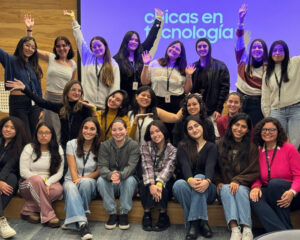
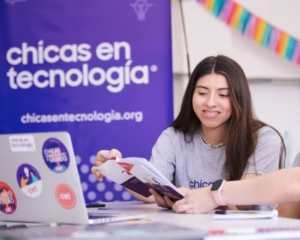
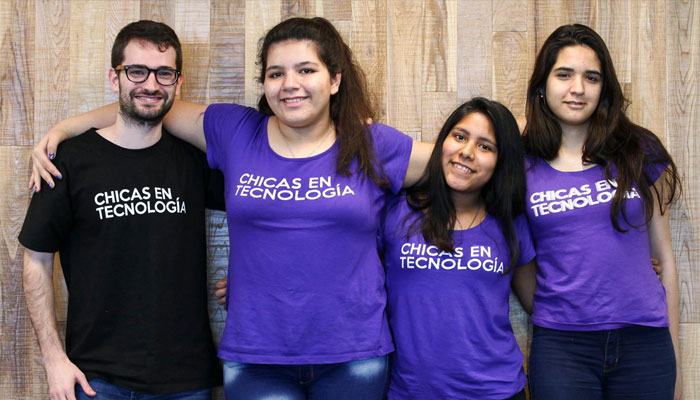
Sofía and María Eugenia Romero with their mentor in the seventh edition of Chicas en Tecnología's Programando un Mundo Mejor (Programming a Better World) program.
I interviewed two Open Leaders 6 participants, Sofia and Maria Eugenia Romero to learn more about their +Escuelas project and how others can contribute or collaborate with their work.
Q: What is +schools?
A:+Schools is an app whose mission is to improve the student's academic life, improving their academic performance through class monitoring, and tools such as a notebook and a calendar, which help the student to get organized.
Q: Why did you start +schools?
A: We started it in Chicas en Tecnología in 2017 with another colleague. The challenge we were given was to make an application with which we could solve a problem that was in our day to day; we at the school saw the low performance and school dropout of students, so we decided to make this application. A good example of this: we observed that more and more girls who became pregnant were dropping out of school. We were looking for a way for them not to drop out of school, just because they were pregnant, as it is key for their later development. With our application we want everyone to have the opportunity to study.
Q: Why do you think it is important to incorporate mobile technology in secondary education?
A: Mobile technology as a technological device works just like the computers we are given in schools, and it has some advantages: it is lighter, it does not have lockout dates, and it has very few technical problems. If students learn to use mobile technology in a good way, the cell phone could become an excellent tool: with it we can access the Internet, make notes, any task we need to do. We are in a stage of exploration and development where technology is everywhere; we believe that learning about technology from an early age, knowing how to use it and how to take care of it, will better prepare us for the world around us. Our application, +escuelas, is a contribution in this sense because it is designed especially for high school students. We wanted to help students with a tool that is technology, the cell phone, in schools. We also wanted to show the directors and teachers that the cell phone is not only a “distraction” but a very useful tool nowadays.
Q: What challenges have you encountered in the development of this project?
A: The challenges we faced were:
Participating in a program where everything happened in English. For the first time we had to face an experience where we had to speak, write and understand everything that happened in the cohort calls. Although we have a background in the language, it was a big disadvantage not to speak it so often.
As we are students without much preparation in design and programming, it is very difficult for us to develop or program the app, so every time we learn something we try to incorporate it, although with difficulty.
At school, although we have a computer science orientation, the teachers are not very prepared to help us since the orientation is new, so we could not count on them for much help.
Q: What skills does a person need to have to be able to contribute to your project?
A: We are looking for developers, designers, code structure experts, and education experts. We are looking for these branches of contributors because, as high school students, we don't have as much preparation, we don't know how to make the app well designed or have the functionalities we want it to have. Education experts could help us to design strategies to approach young people, what things we need to know about them. The most important thing: a lot of patience and willingness to collaborate in our project 😉.
Q: How can others contribute to your project?
A: You can contribute by making a comment to continue improving, or sharing our app so that other people can get to know it and make it more viral. Whatever everyone wants to do, what counts is to help and we are always looking to improve.
For example a designer who can create our logo or who can make the app look serious but at the same time not boring, which is quite difficult to achieve.
In terms of programming we need someone to help us to move the app from app inventor to a platform where it can be shared and so that many more people can access the project by collaborating.
In terms of education specialists could help us on how to get the information in a more appropriate way to the students; how to organize the app itself so that its use is effective and understandable.
Q: How did the Open Leaders program help you with your project?
A: This program helped us a lot to plan our project, to understand what we want to achieve with it or what functions we want our app to have. Even though when we started to put together the project we had the central idea, as we progressed more and more things came to mind and we didn't have a concrete idea for our app. With this program we were able to concentrate, focus on something concrete and explain the project in a clearer way. Open Leaders also taught us many things we didn't know, for example, how to use Github, or how to share your project in different channels. It was our first experience in an international program; at the beginning we have to admit that we were nervous because we didn't know what we were going to find, but along the program we started to feel more comfortable and we can share our opinions and views with others without any problem. We had a fantastic experience, we were able to grow a lot and we want to thank our mentors, who were very willing to help us at all times and without them we would have been lost. Thank you Sabrina Izcovich, Laura Rodriguez, Laura Morinigo and María Cruz ❤.
Yes, the program helped us a lot in the project because we were able to have a clearer vision of what we want the app to have, the vision we have of the app, what we want to achieve with it. In addition, the program helped us to see not only the scope we want to have with the app in, for example, one year, but we had to think for example in a 20-year term and we could expand the horizons of our app and not only take the results of effectiveness in the school but this app could in the distant future become a global app helping millions of students. Sometimes it is not so difficult to dream, if you put your mind to what you believe in, it could become a reality.
Q: Would you recommend the program and why?
A: Yes, we recommend the program because it was a very nice experience, we were able to grow a lot with our project. Participating in experiences like these is super rewarding, the opportunity to participate in an international program does not happen every day then. The organization of the Open Leaders program is very accessible: during the group calls, reading the notes helps a lot to be able to follow the topics discussed. Considering that the program is all English, if English is not your first language, you might be scared, but don't worry, it's not as bad as it sounds. We must admit that we were scared in our first cohort meeting but everything was very dynamic. If you are lucky enough to participate in the program, you will not regret it. We do not regret it and we thank open leaders for inviting us to participate, it was a unique experience.
Q: (Optional question - Bonus) Is there a meme or GIF that describes your project well?
R:
Source: https://giphy.com/gifs/cat-computer-working-11JTxkrmq4bGE0
[gdlr_video url=”https://youtu.be/VGKJN-cWvs” ]
Watch Sofía and María Eugenia's presentation of their project at the Open Leaders Demo Call (starts at minute 38:35):
— —
Sofía and María Eugenia are high school students in Buenos Aires, Argentina. They participated in the Mozilla Open Leaders program thanks to a collaboration between the Mozilla Foundation and Chicas en Tecnología, where they took their first steps in tech.